Until the mid-20th century, boarding houses were a vital pillar of the U.S. housing market – a temporary home for millions. Yet, within just a few years, they largely vanished from the urban landscape and collective memory.
In this article, we explore the meaning behind the term, where these accommodations originally emerged, what people around the world associate with it today, and why Germany is an outlier in this regard.
Table Of Contents
Etymology
The term boarding house is derived from the noun board, not from the verb to board in the sense of "to go on board". Board first meant "a plank, a flat piece of wood". In late Old English, its meaning broadened to "table". By the 14th century it had taken on the figurative sense of “food” – what is placed on the table – and from there came the meaning "daily meals provided at a place of lodging".[1]
In its literal sense, a boarding house is a house where one is provided with both food and lodging.
There are differing accounts of when the term was first used: while the Oxford English Dictionary cites 1728 as the earliest attested use, Merriam-Webster dates it to 1680.[2]
Boarding Houses in the USA
Around 1830, boarding houses became very popular in the United States. They emerged as a response to rising property prices and housing shortages in the major cities. In Boston of the 1830s, for example, an estimated 50% of the total population lived in a boarding house at some point:
In 1842, the poet Walt Whitman referred to Americans as “a boarding people.” New York city was the “capital” of boarding houses at that time, and Whitman noted that fully 75% of Manhattan’s adult population either had lived or were currently living in boardinghouses. In Boston in the 1830’s, between 33% to 50% of the city’s entire population lived in boarding houses.[3]
The boarding houses of that time mostly were small accommodations in private homes, often run by widowed women.[4] In addition to accommodation, meals were included in the price. Guests gathered in the dining rooms to eat together.
The accommodations were used by students, workers, immigrants, and newlywed couples who moved to the city. Vacationers and families rented the accommodations as an inexpensive alternative to hotels. Many prominent Americans, such as Edgar Allan Poe and Herman Melville (Moby Dick), also lived in boarding houses from time to time. So it was by no means only low-income earners who used and appreciated this type of accommodation.[3]
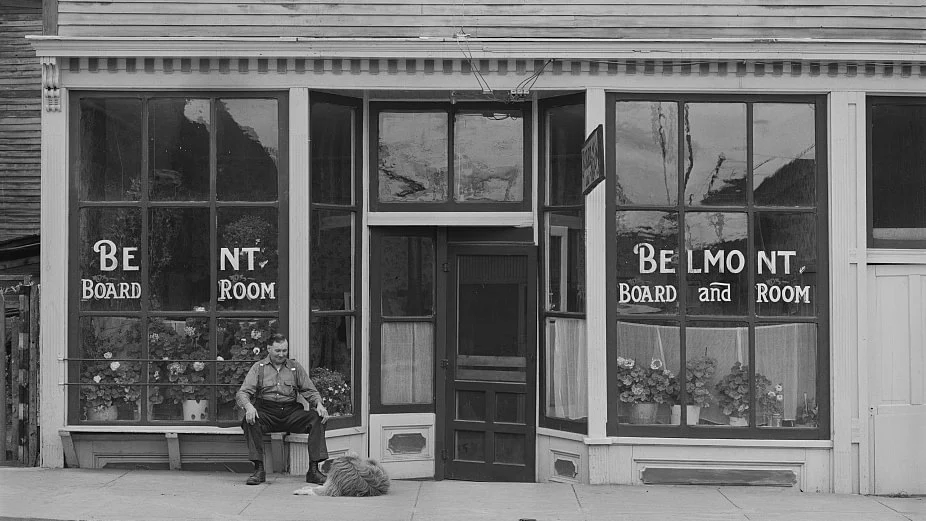
Starting in the 1920s, society's attitude toward boarding houses slowly changed. They were increasingly seen as outdated and morally questionable, partly because they brought together people of different social classes, skin colors, and lifestyles under one roof. Politicians responded with strict building codes (zoning laws) and regulations that pushed these accommodations out of many residential areas.[3]
With the housing boom of the 1950s, many members of the middle class were able to finance their own apartments or houses for the first time, causing boarding houses to lose further significance. Today, they play only a minor role in the housing market and tend to have a negative connotation as accommodation for the socially disadvantaged.
Boarding Houses in the UK
In the 19th century, boarding houses in the United Kingdom were often small, privately run accommodations that offered room and board to travelers, workers, or homeless people – comparable to the American model. However, there were also houses that catered to a more affluent clientele:
A favorite resort of the homeless are boarding-houses. Of these establishments there are hundreds in London – from those devoted to the entertainment of minor City clerks, rigorously „engaged during the day,“ to those which – one is almost led to suppose – nobody under the rank of a baronet is received, and even then not without a reference as to respectability on the part of a peer. But most of these houses have one or two features in common. There is always a large admixture of people who go there for the sake of society.[5]
From the middle of the 20th century onwards, these types of accommodation became increasingly irrelevant and were replaced by more modern forms of housing, such as "houses in multiple occupation".
Nowadays, in the UK, the term boarding house is almost exclusively used in the context of boarding schools, referring to the buildings where students sleep and live together. Well-known examples include the boarding houses at Harrow School or Eton College.
Boarding Houses in Australia
In the late 19th century, boarding houses also began to spread across Australia, often in cities and gold mining regions, such as the “Chinese Boarding House” in Gulgong (ca. 1873).

Like in the US, these accommodations were mostly run by women and were popular not only among the poorer segments of the population:
In the early part of the twentieth century, however, boarding houses were a reasonably common dwelling choice, and provided accommodation for between 5 to 10 percent of Melbourne’s population, including the rich and famous. […] Usually run by women, boarding houses provided safe and respectable shelter, daily meals as well as laundry and other housekeeping services. The tenants were mainly younger men, but also included couples, single women, and families unable or unwilling to cater for themselves in their own private dwellings.[6]
The term "boarding house” is still in common use today and generally refers to affordable, shared accommodations—regardless of whether meals or other services are provided.[6]
A distinction should be made, however, between the accommodations of boarding schools (as in the United Kingdom) and “general” boarding houses. The latter are clearly defined and regulated in several states, such as under the NSW Boarding Houses Act 2012.[7]
Although Australian policymakers view boarding houses as a vital pillar of affordable housing and provide some level of support, the number of such accommodations is declining. Among the reasons for this are the ongoing gentrification of inner-city neighborhoods, stricter regulatory requirements, and skyrocketing insurance premiums, which make operating these properties financially unviable.[6]
Just like in the U.S., boarding houses don’t have a good reputation in Australia today. People generally don’t choose to live in them; they do so because they have no other choice. During the COVID-19 pandemic, they were also considered hotspots due to cramped living conditions and shared bathrooms.
Boardinghäuser in Germany
In Germany, boarding houses gained popularity in the 1930s. A notable example is the "Boarding-Haus" building type, which was showcased at the 1931 German Building Exhibition in Berlin.
This model boarding house was exhibited in the department "Die Wohnung unserer Zeit" (lit. The apartment of our time) and featured various apartment types ("for single men", "for single women", "for two women", "for married couples", and "for intellectual workers"). Each apartment included a kitchenette and a sleeping area separated by a curtain or folding doors. On the ground floor, there was also a restaurant and common rooms.[8]

The label was intended to convey a progressive and cosmopolitan mindset, but, as M. Eisen notes, it had little in common with the classic boarding houses in the US, which were already in decline at that time:
In America, boarding houses were small guesthouses set up in private homes, often run by widowed women. These houses already had a clearly negative connotation in the interwar period [...]. In 1890, there were 928 such boarding houses in Chicago alone, but by 1915 there were only 230. Their heyday was long gone. To make matters worse, the so-called "Boarding Palace" had opened on Kurfürstendamm in 1912, a spectacular project that sought to offer wealthy visitors to Berlin “all the refined and luxurious comforts of a modern hotel in combination with the privacy of an cozy apartment.”[4]
In contrast to the rest of the world, boarding houses have been very popular in Germany for years. There is hardly a village around the major cities that does not have one. And to this day, the term is understood to mean something completely different than in the English-speaking world.
While there it is primarily understood as an inexpensive form of housing with shared facilities for students or the socially disadvantaged, Boardinghouses in Germany often provide high-quality furnished apartments including limited hotel-like services for temporary stays.

These so-called serviced apartments are predominantly located in larger, professionally managed apartment buildings. As a rule, meals are not included in the service – the 'boarding' in the name is therefore actually misleading.
The Bottom Line
The results of our brief research were surprising, as it became clear that Germany is an outlier. The term boardinghouse is not only "outdated", as Apartmentservice[9] writes, but from the very beginning had little to do with the understanding of the concept in the English-speaking world.
While the label carries a rather negative connotation in some countries today, in many parts of the world the concept is virtually unknown. When addressing international guests, it is therefore preferable to drop it in favor of the more widely recognized, self-explanatory term "Serviced Apartment".
References and Sources
- Harper, Etymology of board, Online Etymology Dictionary. Link
- Merriam-Webster, Boardinghouse. Link
- Housing Solutions Blog, A History of Boarding Houses: Ideal Forms of Affordable Housing. Link
- Eisen, M. (2018), Neues Wohnen für Neue Menschen: Ledigenheime als Programmbauten der Moderne in der späten Weimarer Republik. RIHA Journal 0185, Rn 31. Link
- Lee Jackson, Lodgings and boarding-houses, Dictionary of Victorian London. Link
- Greenhalgh et al. (2004), Boarding Houses and government supply-side intervention, AHURI Final Report No. 54, Australian Housing and Urban Research Institute Limited, Melbourne. Link.
- NSW Boarding Houses Act 2012 No 47. Link
- Vorhoelzer et al. (1931), Wohnräume im Boarding-Haus. Innendekoration 42, S. 273ff. Link
- Apartmentservice, Boardinghouse: A different meaning in German. Link